
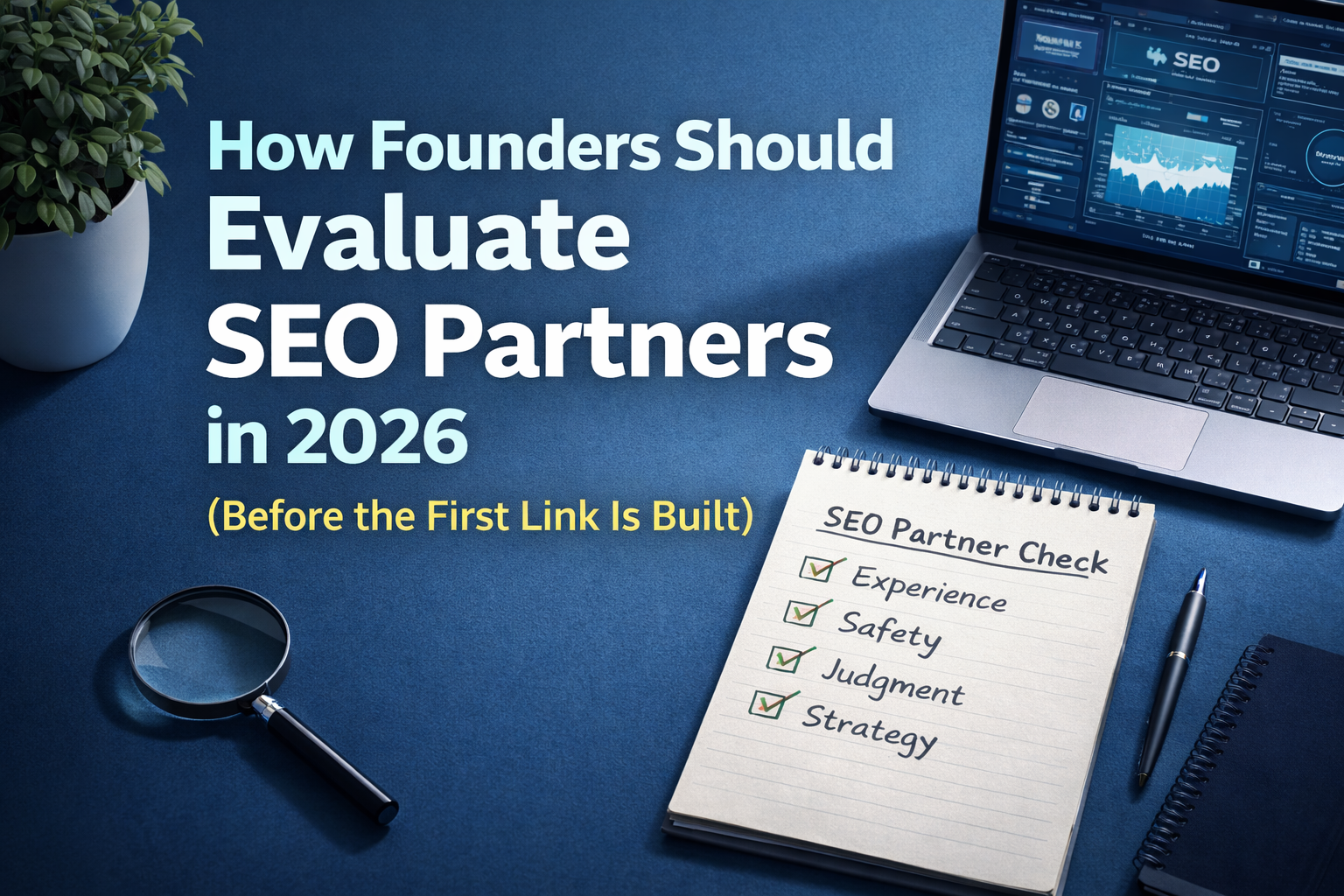
How Founders Should Evaluate SEO Partners in 2026 (Before the First Link Is Built)
Most SEO damage doesn’t come from bad tactics, it comes from early decisions that compound quietly. This piece breaks down how founders should evaluate SEO partners in 2026, before execution begins and before momentum becomes hard to undo.
SEO STRATEGYLINK BUILDING STRATEGYBRAND-SAFE SEO FRAMEWORKS
Arghyadip — Founder, Growth Outreach Lab
2/9/2026
Why this matters more in 2026 than ever before
Most founders don’t lose money on SEO because they picked a “bad” agency.
They lose money because they picked the wrong kind of partner for the stage they were in, and didn’t realize it until months later.
By the time the signals show up in traffic, rankings, or links, the damage has already been baked in.
2026 SEO is less about tactics and more about judgment.
Everyone has access to tools.
Everyone knows the playbooks.
Everyone can show screenshots, dashboards, and growth curves.
The real difference between a good SEO partner and a costly one is how they think before execution even begins.
That’s what this piece is about.
Not how to build links.
Not how to rank pages.
But how founders should evaluate SEO partners before trusting them with momentum they can’t easily undo.
The first mistake founders make (without realizing it)
Most founders evaluate SEO partners the same way they evaluate vendors.
They ask:
What services do you offer?
How many links do we get per month?
What tools do you use?
How fast can we scale?
These are normal questions.
They’re also the wrong ones.
Because SEO partners aren’t vendors in the traditional sense.
They’re execution partners.
And execution compounds — both positively and negatively.
A bad hire in paid ads wastes budget.
A bad hire in SEO quietly changes the trajectory of your site.
Founders often don’t realize this because early SEO damage doesn’t look dramatic. It looks like:
activity without clarity
progress that doesn’t compound
links that exist but don’t strengthen anything
content that ranks “a bit” but never becomes a moat
None of this triggers alarms.
It just creates friction that slows growth later.
What strong SEO partners optimize for (and weak ones don’t)
Here’s a simple lens most founders miss:
Weak SEO partners optimize for output.
Strong SEO partners optimize for second-order effects.
Output looks impressive on paper:
number of links
number of pages
velocity
delivery timelines
Second-order effects are quieter:
how links change internal authority flow
how early content choices limit future expansion
how anchor decisions shape risk over time
how outreach targets affect long-term trust signals
If an SEO partner only talks in outputs, you’re hiring labor.
If they talk in constraints, trade-offs, and sequencing, you’re talking to someone who understands execution risk.
This distinction matters far more than most founders realize.
The “speed” trap: why fast SEO feels good but breaks later
One of the most common patterns I see from the execution side is this:
A founder hires an SEO partner.
The partner wants to “prove value” quickly.
So they move fast.
Links go live early.
Content gets pushed without enough internal context.
Anchor strategies get decided before the site has earned flexibility.
Everything looks productive.
But SEO isn’t linear. It’s layered.
And when you move too fast before the base layer is stable, you lock in decisions that are hard to reverse:
anchor profiles that limit future link types
topical paths that fragment authority
publisher relationships that can’t scale cleanly
Good partners slow down on purpose early.
Not because they lack confidence — but because they understand that the first 60–90 days shape the ceiling of everything that comes after.
If an SEO partner is obsessed with speed before understanding structure, that’s a signal worth paying attention to.
How experienced partners talk about links (and inexperienced ones don’t)
Here’s something subtle but important.
Ask any SEO partner this question:
“In what situations would you not build links?”
Most weak partners will struggle to answer.
They’ll default to:
“It depends on the niche”
“We always build links safely”
“As long as it’s white-hat, it’s fine”
Strong partners answer differently.
They’ll talk about:
pages that shouldn’t attract links yet
timing mismatches between content and authority
cases where internal signals need fixing first
situations where link velocity creates more risk than upside
This matters because SEO maturity isn’t about knowing how to build links.
It’s about knowing when not to.
If a partner treats links as a constant instead of a lever, they’re optimizing for activity, not outcomes.
A simple test founders can use early
You don’t need to be technical to evaluate SEO judgment.
You just need to listen for how they frame uncertainty.
Try this early in the conversation:
“What’s the biggest SEO risk in the first 90 days for a company like ours?”
If the answer is generic, tactical, or defensive — be cautious.
If the answer references:
sequencing mistakes
compounding risk
things that feel boring but foundational
you’re likely talking to someone who’s seen what breaks campaigns after the honeymoon phase.
That perspective doesn’t come from theory.
It comes from cleaning up messes others created.
Why communication style matters more than credentials
Most founders over-index on experience signals:
years in SEO
logos
case studies
tools
But in practice, communication style predicts outcomes better than credentials.
Here’s why.
SEO execution lives in ambiguity.
There are very few moments where something is 100% right or wrong.
Good SEO partners don’t pretend certainty where it doesn’t exist.
They explain trade-offs.
Weak partners hide uncertainty behind confidence.
Strong partners surface it early.
Pay attention to how your SEO partner communicates when:
timelines slip
results plateau
something doesn’t work as expected
Do they:
slow down and explain why
adjust the plan openly
talk about implications, not excuses
Or do they:
add more activity
change metrics
deflect into tools and reports
In 2026, SEO success is less about doing more and more about making fewer wrong decisions.
That only happens when communication is honest, not performative.
The hidden red flags that only appear after onboarding
Most SEO partnerships don’t fail in week one.
They fail quietly between month two and month five.
Here are execution-side red flags founders usually notice too late:
1. Reporting without interpretation
Dashboards look clean.
Numbers move.
But no one explains what changed and what it means next.
Good partners don’t just show metrics — they narrate the story behind them.
If reports answer “what happened” but never “so what?”, that’s a warning sign.
2. Tactics drifting without a clear reason
Anchor strategies change.
Link types shift.
Content priorities move.
But the why isn’t clearly explained.
SEO isn’t static — change is normal.
Unexplained change is not.
Strong partners explain evolution before it happens, not after.
3. Activity increases when clarity decreases
This one is subtle.
When something isn’t working, weak partners often respond by:
building more links
publishing more content
increasing velocity
It feels productive.
But often it’s a way to avoid slowing down and reassessing fundamentals.
Good partners are comfortable saying:
“We need to pause, reassess, and adjust.”
That sentence alone is a trust signal.
Why reporting quality beats dashboards every time
Founders often ask for:
live dashboards
real-time metrics
more granular data
But the best SEO relationships I’ve seen didn’t rely on complex dashboards.
They relied on clear thinking.
A strong SEO report should answer:
What did we do?
Why did we do it?
What changed because of it?
What are we not doing next month — and why?
Notice the last question.
Most reports only focus on what’s added.
Very few explain what’s intentionally excluded.
That’s where judgment shows up.
How strong SEO partners protect downside (not just promise upside)
Upside is easy to sell.
Downside is harder to explain — and far more important.
Strong SEO partners actively protect:
brand risk
future flexibility
authority dilution
decision reversibility
They think in terms of:
“If this doesn’t work, how hard is it to undo?”
Weak partners think:
“This usually works.”
In 2026, SEO isn’t about finding tactics that work “on average”.
It’s about avoiding moves that quietly cap long-term growth.
The most important question founders rarely ask
If you only ask one question before hiring an SEO partner, make it this:
“What SEO decisions are hardest to reverse once they’re made?”
Listen carefully to the answer.
If they talk about:
anchor profiles
topical direction
early link placement
content-authority mismatches
you’re talking to someone who understands compounding risk.
If they struggle to answer, or default to tools and tactics, that’s your signal.
Final thought (from the execution side)
Most SEO failures don’t come from bad intent.
They come from misaligned judgment early on.
Founders don’t need partners who promise growth.
They need partners who:
slow down when it matters
explain trade-offs clearly
protect downside quietly
and think in systems, not sprints
By the time the first link is built, most outcomes are already shaped.
The real evaluation happens before execution begins.
Contact
Get in touch
Partner inquiries:
info@growthoutreachlab.com
© 2026 Growth Outreach Lab | Crafted with strategy & intent.
Your Clients Expect Results.
Make Fulfillment the Easiest Part of Your Agency.
Services
Strategy Sample
Our SEO Process