
What Founders Misunderstand About Link Building (From the Execution Side)
Link building often looks simple from the outside: reach out, place links, grow authority. But from the execution side, things behave very differently. This piece explores the common assumptions founders have about link building—and what actually shapes long-term SEO momentum.
LINK BUILDINGSEO STRATEGYOUTREACH STRATEGY
Arghyadip — Founder, Growth Outreach Lab
3/9/20267 min read
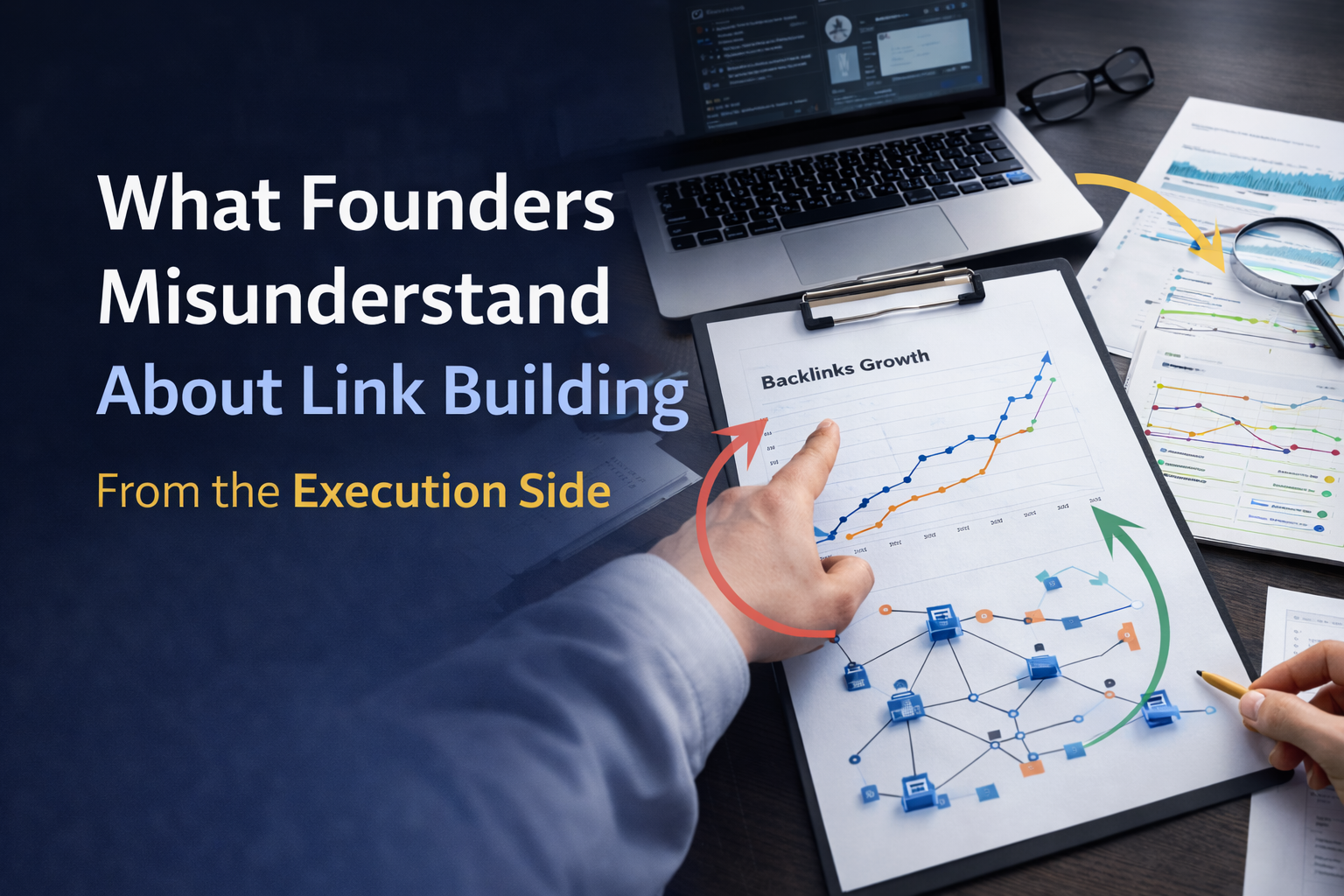
Link building is one of those things that looks simple from the outside.
You reach out to websites.
You place links.
Your authority grows.
Your rankings improve.
At least, that’s how most founders imagine it.
And honestly, that assumption makes sense. From a distance, link building looks like a straightforward growth lever. More links should mean more authority. More authority should mean better rankings.
But from the execution side, things behave very differently.
Many SEO campaigns don’t struggle because the team lacks effort. They struggle because the underlying assumptions about link building were slightly off from the beginning.
Not dramatically wrong.
Just misaligned enough that the campaign slowly loses momentum.
And the difficult part is this:
Those problems rarely show up immediately.
In the first few months, everything can look healthy. Links are going live. Reports show activity. Metrics move just enough to keep confidence high.
Then growth plateaus.
Not suddenly. Quietly.
And at that point, most teams try to solve the problem by doing more of the same thing.
More links.
More outreach.
More velocity.
But the issue usually isn’t volume.
It’s understanding what links are actually doing to the site.
Before we talk about strategy or tactics, it helps to address a few assumptions that many founders naturally carry into link building discussions.
None of these misunderstandings come from a lack of intelligence.
They come from the fact that link building behaves very differently on the inside than it appears from the outside.
Misunderstanding #1: “More links means faster growth”
This is probably the most common assumption.
If links help rankings, then more links should accelerate progress.
And in some cases, that logic works.
But most sustainable SEO campaigns aren’t built on raw link volume. They’re built on how authority flows through the site after links are earned.
A single well-placed link to the right page can influence internal authority distribution across multiple pages.
Meanwhile, ten links to the wrong location can create almost no meaningful movement.
This is where many campaigns quietly lose efficiency.
Links get placed.
Metrics increase.
But the links are pointing to pages that don’t meaningfully strengthen the broader structure of the site.
From a reporting perspective, the campaign still looks productive.
From an authority perspective, the impact is limited.
Experienced teams spend a surprising amount of time deciding where links should go before they ever reach out to publishers.
Because once a link is placed, it becomes part of the site’s authority structure.
Changing that structure later is much harder than planning it correctly in the first place.
Misunderstanding #2: “High DR sites automatically create strong links”
Another common belief is that link quality is mostly determined by the domain metrics of the site providing the link.
Metrics like Domain Rating or Domain Authority are useful directional signals.
But they rarely tell the full story.
A link from a high-DR site can still have very little impact if:
the article has no topical relevance
the page receives little real traffic
the link placement lacks contextual strength
the surrounding content doesn’t reinforce the topic
Meanwhile, a link from a more modest site can sometimes deliver far more value if:
the topic alignment is strong
the audience overlaps with your niche
the page itself attracts organic traffic
the link sits naturally within the content
In other words, context often matters more than metrics.
But context is harder to quantify.
Metrics are easy to show in a spreadsheet. Context requires judgement.
And judgement is where experienced link building teams spend most of their energy.
Misunderstanding #3: “Outreach is mainly a numbers game”
From the outside, outreach often looks like a simple scaling process.
Send more emails.
Contact more publishers.
Secure more placements.
And early on, that approach can work.
But outreach has limits that many founders don’t immediately see.
Publishers talk to each other.
Editorial teams notice patterns.
If outreach becomes purely mechanical, the campaign can gradually start hitting invisible walls.
Response rates drop.
Placement quality declines.
And relationships that could have produced long-term opportunities get burned through too quickly.
Strong outreach teams don’t only optimise for response rates.
They optimise for publisher trust over time.
That means being selective about who you approach, how often you approach them, and what kind of placements you request.
Because once a publisher loses trust in an outreach source, rebuilding that relationship is difficult.
And publisher relationships are one of the quiet assets that separate strong link building operations from short-lived ones.
Misunderstanding #4: “Anchor text is just a keyword decision”
Many founders see anchor text as a simple SEO variable.
Choose the keyword you want to rank for.
Use it in links.
Improve relevance.
But anchor text shapes far more than keyword signals.
It also influences how natural or risky a link profile appears over time.
If anchor choices become too predictable or overly optimised, the link profile begins to lose diversity.
And diversity is one of the strongest natural signals search engines observe in link ecosystems.
Experienced teams rarely decide anchors based on individual links.
They decide anchors based on the long-term profile that dozens or hundreds of links will create together.
In other words, anchors are less about single placements and more about the pattern they create over time.
That kind of thinking rarely appears in simple link reports.
But it’s one of the quiet factors that protects long-term growth.
Why these misunderstandings happen
None of these misunderstandings exist because founders are careless.
They exist because link building is usually presented as a tactical service.
But in reality, it behaves more like a system that interacts with the entire structure of a site.
Links influence authority flow.
Authority flow influences which pages grow.
Which pages grow influences how topical authority forms.
And topical authority ultimately shapes long-term search visibility.
In other words, link building is rarely just about acquiring links.
It’s about shaping how authority moves through the site over time.
And that’s where execution decisions start to matter far more than most reports reveal.
What Experienced Teams Actually Pay Attention To
Once teams move beyond the early assumptions about link building, their attention shifts to very different questions.
They stop asking:
“How many links can we build this month?”
And start asking:
“What kind of authority structure are we slowly creating?”
Because strong SEO campaigns are rarely built on bursts of activity.
They’re built on quiet consistency that compounds over time.
That shift in thinking changes almost every decision that happens during link building.
What experienced teams look at before building links
Before a single outreach email goes out, experienced teams usually spend time studying the site itself.
Not just the domain.
The structure.
Which pages currently hold authority.
Which pages are supposed to become authority hubs.
Where internal links already concentrate power.
Because link building works best when it strengthens a structure that already makes sense.
If the internal structure is fragmented, links often struggle to create meaningful momentum.
Instead of reinforcing a clear authority path, they scatter influence across unrelated pages.
This is why many campaigns quietly stall.
Links were built.
But the authority had nowhere productive to flow.
Why sequencing matters more than most people expect
Another thing experienced teams think about is sequencing.
Not every link should appear at the same stage of a campaign.
Early links often serve a different purpose than later ones.
Early in a campaign, links might focus on strengthening foundational pages. Pages that define the site’s core topics.
Later in a campaign, links might support deeper content clusters or expand the site’s reach into adjacent areas.
If that order is reversed, the authority structure becomes uneven.
Pages that depend on stronger topical foundations get links before those foundations exist.
The campaign still produces links.
But the momentum they generate becomes inconsistent.
Sequencing mistakes rarely show up in dashboards.
But they quietly shape how sustainable the campaign becomes.
Why link velocity is often misunderstood
Link velocity is another concept that gets simplified too easily.
From the outside, faster often seems better.
More placements should mean stronger signals.
But search ecosystems tend to reward patterns that resemble natural growth.
Sudden bursts of link activity followed by long quiet periods can create unusual patterns.
Meanwhile, consistent and steady acquisition tends to reinforce trust signals over time.
Experienced teams don’t only ask:
“How many links can we build?”
They also ask:
“What growth pattern will this create when someone looks at the profile six months from now?”
Because link building doesn’t exist in isolation.
It becomes part of a long-term behavioural pattern search engines observe.
What thoughtful founders eventually start noticing
Interestingly, founders who spend enough time around SEO campaigns begin to notice certain signals themselves.
They start asking questions that go beyond simple outputs.
For example:
Why are certain pages receiving links instead of others?
What changes internally when a link is placed?
How do these links influence the broader authority of the site?
Why does the campaign slow down at certain moments instead of constantly accelerating?
These are the kinds of questions that usually appear once someone realises that link building isn’t just about acquiring placements.
It’s about shaping how influence moves through a digital ecosystem.
And once that shift happens, conversations about SEO become far more productive.
Because the focus moves away from activity.
And toward structure, timing, and long-term resilience.
The quiet truth about link building
From the outside, link building often looks like a tactical service.
From the inside, it behaves more like a slow structural process.
Each link becomes a small decision that influences how authority flows through the site.
Over dozens or hundreds of links, those decisions compound.
Sometimes they compound into strong, stable growth.
Other times they compound into invisible friction that keeps pages hovering just outside meaningful rankings.
The difference rarely comes down to effort.
It comes down to how well the underlying system was understood before execution began.
The most thoughtful founders eventually realise something important about SEO.
The real value of a link building partner isn’t simply their ability to acquire links.
It’s their ability to understand how each link interacts with the structure of the site, the timing of the campaign, and the long-term authority profile being built.
Because once links are placed, they rarely exist in isolation.
They become part of a system.
And the way that system evolves will quietly shape the growth trajectory of the entire site.
Contact
Get in touch
Partner inquiries:
info@growthoutreachlab.com
© 2026 Growth Outreach Lab | Crafted with strategy & intent.
Your Clients Expect Results.
Make Fulfillment the Easiest Part of Your Agency.
Services
Strategy Sample
Our SEO Process