
How We Choose Safe Anchor Text for Modern Brands (A Practical 2025 Framework)
A practical 2025 framework for choosing safe, risk-free anchor text for modern brands. Learn how we protect long-term SEO stability using relevance, editorial context, and anchor-safety judgment—not outdated keyword tactics.
SEOLINK BUILDINGANCHOR TEXT STRATEGY
Arghyadip — Founder, Growth Outreach Lab
12/8/20255 min read
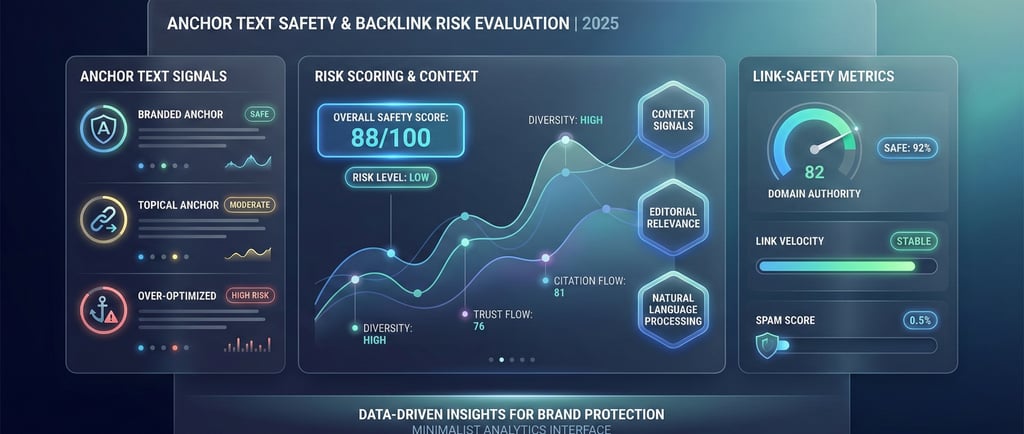
1. Why Anchor Text Is a Brand-Safety Issue in 2025
Most founders still think anchor text is “the keyword you want to rank for.”
In 2025, anchor text is no longer a ranking trick — it’s a risk signal.
Google’s pattern detection has become far more aggressive, and backlinks are now evaluated based on intent and context, not just the clickable words. Over-optimized anchors, forced keyword placements, AI-generated backlinks, and link farms repeating commercial phrases across dozens of domains have made anchor misuse one of the fastest ways to damage a brand’s long-term SEO profile.
The truth is simple:
anchors can either protect your brand or expose it.
If you don’t understand anchor safety, you don’t understand backlink safety.
And that’s exactly why Growth Outreach Lab built a framework that prioritizes risk reduction over keyword manipulation.
2. Why Old Anchor Text Advice No Longer Works
Before 2022, the common anchor strategy went something like:
Use exact-match keywords frequently
Insert keyword anchors across multiple domains
Mix in some partial-match to “look natural”
Let the publisher place anchors wherever they want
That playbook doesn’t survive in 2025.
Here’s why:
Exact-match patterns are detectable.
When the same commercial phrase appears repeatedly across unrelated publishers, Google doesn’t see “relevance” — it sees engineering.
Networks reuse the same anchors.
AI farms and link sellers insert identical money-anchors for every buyer. If your anchor resembles the previous fifty placements, the signal is toxic.
Founders still push “keyword anchors” into irrelevant content.
If the article’s argument doesn’t naturally support the anchor, Google treats it as manipulation, not context.
Google now rewards contextual meaning, not keyword density.
If the intent of the surrounding paragraph doesn’t match the anchor, the anchor weakens the link instead of strengthening it.
The old approach wasn’t just outdated — it now creates volatility and long-term risk.
3. Growth Outreach Lab’s Real Anchor Selection Framework (Step-by-Step)
Our anchor choices don’t come from templates or checklists.
They come from a framework built after managing hundreds of campaigns and reviewing thousands of editorial placements.
Here is how we choose anchor text — every time.
Step 1 — Brand Risk Assessment
We first look at the brand’s current footprint:
Is the domain new?
Is topical authority still developing?
Are there any past risky anchors?
A new or fragile domain cannot absorb aggressive anchors. Stability comes before ambition.
Step 2 — Page Intent & Topic Mapping
We identify what the link supports, not what the brand wants to rank for.
If the publisher’s article is about “workflow automation,” the anchor must reflect that context.
Anchor choice follows intent, not wishful keywords.
Step 3 — Contextual Fit Test
We test whether the sentence surrounding the anchor naturally leads to the brand’s mention.
If we must force the anchor, the anchor is wrong.
Step 4 — Anchor Safety Score
Our internal hierarchy, safest to riskiest:
Branded (BrandName)
Branded + Descriptor (“BrandName insights”)
Contextual (anchor derived from the article’s own language)
Partial Match (only when justified)
Exact Match (rarely safe, used only in very narrow conditions)
The lower you move on that list, the higher the risk.
Step 5 — Traffic & History Influence
Older, editorially consistent sites allow more flexible anchor types.
Newer or previously low-quality sites only get branded anchors.
Step 6 — Publisher Fit Filter
Some publishers write in a conversational editorial tone — these allow contextual anchors.
Others are structured like reference guides — these require branded anchors to avoid disrupting flow.
Step 7 — Relevance-First Decision Making
Anchor selection ends only when we confirm the anchor, page, paragraph, and topic all align.
When relevance is real, anchor safety follows automatically.
4. Deep Explanation of Anchor Types (From a Risk Perspective)
Branded Anchors
These are the safest anchors in modern SEO.
They blend into almost any editorial context and communicate legitimacy rather than manipulation.
Branded + Descriptor Anchors
Examples:
“BrandName platform”
“BrandName insights”
“BrandName guide”
These anchors add context without risking over-optimization. Ideal for SaaS and agencies.
Contextual Anchors
These are taken from the article’s own language — not keywords.
For example, in a workflow automation article, an anchor like “streamline your processes” may be safer than any keyword variation.
Partial-Match Anchors
Acceptable only when the topic genuinely aligns.
If a finance tool appears in an article about financial operations, a soft partial match makes sense.
If the match feels engineered, the anchor becomes a liability.
Exact-Match Anchors
These are rarely safe in 2025.
Google notices repeating patterns, especially when identical anchors appear on unrelated sites.
We only use exact-match when:
the publisher’s article is specifically about that topic,
the domain is strong,
the brand already has a stable anchor profile, and
the paragraph naturally demands that phrase.
Only then does exact-match become editorial instead of manipulative.
5. How We Avoid Dangerous Anchors (Real Red Flags)
Over the years, we’ve built a Mental Red Flag Checklist.
If any of these appear, the anchor is rejected.
Keyword anchors repeated across multiple placements
Anchors inserted into irrelevant or weakly related articles
Money anchors placed on low-quality or commercial-heavy sites
Anchors matching other brands’ anchors in a link seller’s network
Forced anchors that disrupt the sentence or rely on generic phrasing
Unsafe anchors do more damage than bad backlinks.
They distort the brand’s link profile, create detectable patterns, and invite volatility.
6. Real Outreach Examples (Mini Case Studies)
Example A — SaaS Brand (Branded Anchor Only)
We placed a link on a high-authority operational insights publisher.
Although the article was adjacent to the brand’s topic, the context wasn’t tight enough to justify a partial-match.
A branded anchor was the safest choice, and it blended perfectly into the narrative.
Example B — Finance Site (Partial-Match Allowed)
A reputable finance blog published a deep dive on SMB cash flow.
The brand offered bookkeeping automation tools.
Here, a soft partial-match anchor made editorial sense because the article itself referenced the need for automation.
Context justified the anchor — not the keyword.
Example C — Early-Stage Startup (Exact-Match Avoided)
A startup wanted an exact-match anchor for a competitive term.
Their domain was new, with no anchor diversity and no historical authority.
Using an exact-match anchor would have created an aggressive signal and an unnatural link footprint.
We used a branded anchor instead to protect long-term stability.
7. How Anchor Text Fits Into Long-Term Backlink Safety
Anchor choice is one of the few factors that can make or break a link, even if the publisher is perfect.
Safe anchor strategies:
Reduce volatility
Prevent algorithmic suppression
Strengthen domain trust
Support slow, reliable ranking growth
Keep anchor distribution natural
Create resilience during algorithm updates
Founders who want a stable backlink profile must understand:
Anchor safety is brand safety.
A link is never just a link — it’s a long-term signal of how your brand interacts with the web.
8. Authority-Driven Conclusion
At Growth Outreach Lab, we don’t choose anchors because they “help rankings.”
We choose anchors because they protect brands.
Our model prioritizes judgment, relevance, and editorial fit — not templates or outdated checklists.
This is why agencies and SaaS teams trust us to build backlink profiles that are durable, defensible, and aligned with how Google evaluates context in 2025.
Modern SEO rewards sophistication, not shortcuts.
Anchor text decisions reflect whether you understand the landscape or you’re still following old playbooks.
If you want backlinks that enhance trust, not risk it, anchor safety must be the starting point — not an afterthought.
Contact
Get in touch
Partner inquiries:
info@growthoutreachlab.com
© 2026 Growth Outreach Lab | Crafted with strategy & intent.
Your Clients Expect Results.
Make Fulfillment the Easiest Part of Your Agency.
Services
Strategy Sample
Our SEO Process