
The 2025 Playbook for Building Brand-Safe Backlinks: How We Judge Relevance, Authority, and Risk Before Outreach
A practitioner-level 2025 framework for building brand-safe backlinks. Learn how Growth Outreach Lab evaluates relevance, authority, and risk before outreach to protect modern brands from penalties and unstable link profiles.
LINK BUILDINGLINK SAFETYPUBLISHER EVALUATIONMODERN BRAND-SAFE SEO FRAMEWORKS
Arghyadip — Founder, Growth Outreach Lab
12/9/20255 min read
Backlink building hasn’t gotten harder in 2025 — it has simply become less forgiving.
Brands aren’t losing rankings because of too few backlinks. They’re losing them because of the wrong backlinks:
Low editorial standards. Hidden networks. Manipulated anchors. Category mismatches.
Content farms disguised as “guest post websites.”
And the founders I speak with regularly all fear the same thing:
“We can't afford a link penalty or a quality downgrade — one wrong pattern and Google pulls the plug.”
That fear is valid.
Because today, Google doesn’t just evaluate a backlink.
It evaluates your judgment.
This playbook explains how we do it at Growth Outreach Lab — the same evaluation logic we’ve developed after reviewing 4,000+ publishers and building brand-safe, editorial-quality link profiles for US/UK brands.
This is not theory.
This is how we actually qualify websites before we ever reach out.
Why “Brand-Safe Link Building” Matters More in 2025 Than Ever
The SEO landscape in 2025 operates on a single principle:
Google rewards intent and relevance — and punishes detectable manipulation.
Three major updates shifted the game:
1. Topical Misalignment Penalties
Links from unrelated categories don’t pass value anymore — and may actively harm trust.
A SaaS CRM getting links from a parenting blog? Immediate soft-devaluation.
2. Pattern Detection Becoming Ruthless
Google no longer waits for “spam” anchors.
It detects footprints:
Sites with the same publishing cadence
Same outbound linking patterns
Clusters of sponsored posts
AI-written, recycled content sets
3. Brand Reputation Now Tied to Backlink Neighborhoods
If your site is consistently associated with low-quality neighborhoods, your brand reputation score — not an official metric, but absolutely a real signal — takes a measurable hit.
This is why “brand-safe” is not a nice-to-have.
It’s the difference between stable growth and hidden decay.
What Most Agencies Get Wrong (and the Risk Signals They Ignore)
Many agencies still qualify sites using:
DR, traffic, and a quick skim.
That approach stopped working in 2022.
The risks they miss are the ones Google picks up instantly:
1. Outbound Link Footprints
If every article on a site contains 3–5 unnatural outbound links placed mid-sentence → it’s a paid post farm.
2. Non-Human Editorial Tone
AI content with no editorial identity, no narrative, and no context depth is now a major red flag.
3. Topic Drift
A health site publishing VPN reviews…
A fintech blog publishing dating offers…
Topic drift = network-driven site = risky.
4. Churn-and-Burn Publishing Cadence
Sites that publish 20–40 new posts per week, all with commercial anchors, are not “editorial.”
They’re marketplaces.
5. Anchor Manipulation Patterns
Even if your anchor is clean, your placement sits among dozens of toxic anchors — and Google evaluates the neighborhood.
Agencies ignore these.
We don’t.
Growth Outreach Lab’s 2025 Evaluation Framework (Real Practitioner Playbook)
Our framework is built on thousands of real reviews and hundreds of placements.
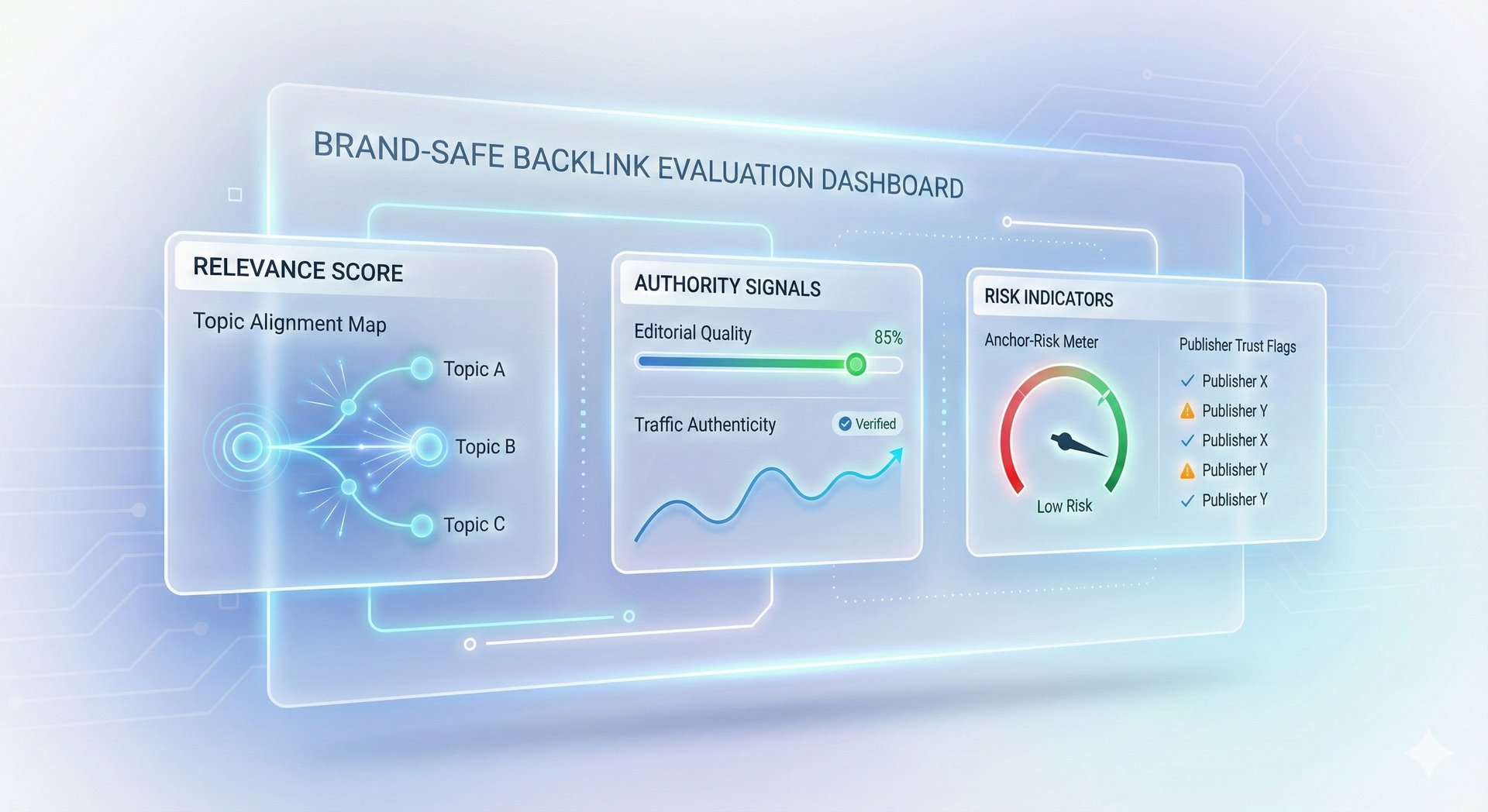
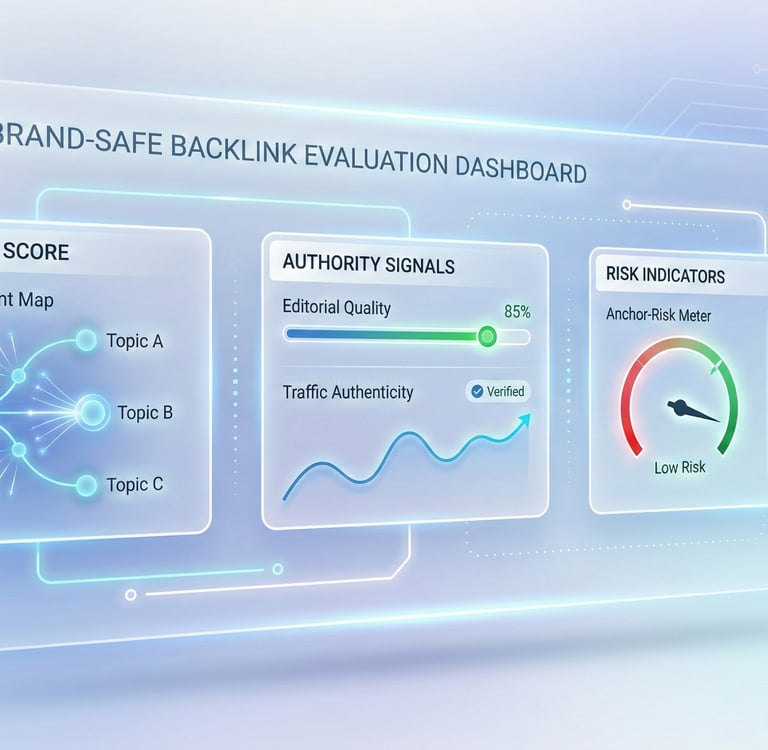
We evaluate publishers using three independent layers, each with its own scoring logic:
Relevance — Does the site naturally fit the client’s topic?
Authority — Does the site demonstrate trustworthiness beyond metrics?
Risk — Will this link raise, lower, or stabilize the brand’s backlink profile quality?
Most outreach teams check only one.
We check all three — in that order.
1. How We Judge Relevance (The Foundation of Brand-Safe Links)
Relevance is not a category label.
It’s an editorial identity.
We qualify relevance using five practitioner criteria:
1. Contextual Theme of the Site
Is the site built around a coherent theme or does it jump categories?
Real example:
A “business blog” covering HR tools, marketing, SaaS, productivity → acceptable.
A “business blog” also covering keto diets and tractor reviews → reject.
2. Page-Level Topic Alignment
We analyze the article where the link will sit:
Does the topic genuinely allow mention of our client?
Can we insert the link naturally without stretching the narrative?
If we have to “force relevance,” we don’t build there.
3. Audience Match
SEO is not about Google alone — it’s about reader expectation.
If the average reader of the site would never care about the client's product → weak relevance → low long-term value.
4. Internal Linking Logic
Sites that internally link chaos-style (everywhere to everywhere) lack editorial guidance.
5. Historical Topics
If the site suddenly shifts direction, we trace when and why.
Topic shifts often indicate ownership changes or monetization pivots.
2. How We Judge Authority (Using Real Trust Signals, Not Vanity Metrics)
Authority isn’t DR.
It's editorial integrity + stability + genuine readership.
We use signals that Google itself tries to interpret:
1. Editorial Tone & Narrative Flow
Does the content feel like it was written by people with knowledge?
Not AI rewrites. Not outsourced templates.
Human editorial tone is increasingly correlated with trust.
2. Traffic Stability, Not Just Volume
Sudden spikes = AI trend chasing.
Sudden drops = algo hit or migration issue.
Stability over 6–12 months is the indicator founders should care about.
3. Brand Presence & Identity
Sites with real brand footprints (newsletter, team page, founder identity) carry far more authority.
Sites with no identity → risk-prone.
4. Category-Level Authority
We check the site’s top-performing categories to determine if it’s actually respected in the niche.
5. External Brand Mentions
If credible sites reference this publisher naturally, that’s real authority.
3. How We Judge Risk (The Part Most Teams Skip — and the Part That Protects Brands)
This is where most agencies collapse.
Risk evaluation is not intuitive unless you’ve approved or rejected thousands of sites.
We score risk using these criteria:
1. Outbound Link Behavior
We look at:
placements per article
placement patterns
anchor diversity
promotional density
If an article contains multiple commercial links → immediate risk flag.
2. Ownership Networks
We map site fingerprints:
Same hosting, same templates, same content patterns.
If a site is part of a detectable network, even if each site looks fine, we reject.
3. Sponsored Post Saturation
If >20–30% of articles contain outbound links → not safe long-term.
4. Indexation Consistency
We look at how many pages are indexed vs published.
Large gaps = algorithmic suppression.
5. Anchor Text Environment
If other brands have used manipulative anchors on the site, Google’s trust in the site is already compromised.
You inherit the neighborhood.
Mini Scenarios (Hypothetical but Based on Real Patterns)
Scenario 1 — The “High DR but Toxic Footprint” Website
A DR 75 finance blog with 800 monthly posts.
Every article contains:
3 outbound links
rich anchors
zero editorial tone
Rejected instantly — it’s a link mill disguised as an authority site.
Scenario 2 — The “Low DR but Safe, Relevant, and Growing” Site
A DR 18 SaaS industry blog with:
real authors
slow consistent publishing
genuine organic search growth
a focused topic cluster
Approved — It will age well, stay safe, and provide long-term authority.
Scenario 3 — Topic Drift Detection
A travel blog begins publishing VPN reviews, credit card content, and fitness supplements.
Rejected — this is the hallmark of a network pivot.
How This Framework Protects Brands Long-Term
Our evaluation filters do one thing extremely well:
They prevent you from entering low-trust link neighborhoods that quietly poison your backlink profile over time.
Our clients get:
Links with stable value
Zero unnatural footprints
Organic anchor diversity
Real editorial context
Better E-E-A-T signals for future updates
This framework was built from real-world errors we’ve seen agencies make — and the recoveries we’ve executed.
Good links drive growth.
Bad links destroy foundations.
Brand-safe link building is simply risk-managed SEO.
Conclusion: The 2025 Standard for Backlink Quality
Founders no longer ask,
“How many links can you build?”
They ask:
“Can you build links that won’t hurt us six months from now?”
And that’s the right question.
Brand-safe backlinks are not the fastest approach — they’re the smartest and the only strategy aligned with where Google is heading.
At Growth Outreach Lab, everything we do is built around this principle:
Relevance first.
Authority second.
Risk scoring always.
It’s how we protect modern brands… and why our link profiles age well, rank well, and survive every update we’ve seen.
Contact
Get in touch
Partner inquiries:
info@growthoutreachlab.com
© 2026 Growth Outreach Lab | Crafted with strategy & intent.
Your Clients Expect Results.
Make Fulfillment the Easiest Part of Your Agency.
Services
Strategy Sample
Our SEO Process