
2025 Framework for Scalable, Brand-Safe Outreach (How We Build Repeatable Systems Without Risking Clients)
A practitioner-level 2025 outreach framework for building scalable, brand-safe editorial links. How we protect clients with relevance, systems, and risk controls.
LINK BUILDINGOUTREACH STRATEGYBRAND-SAFE SEO FRAMEWORKS
Arghyadip — Founder, Growth Outreach Lab
12/11/2025
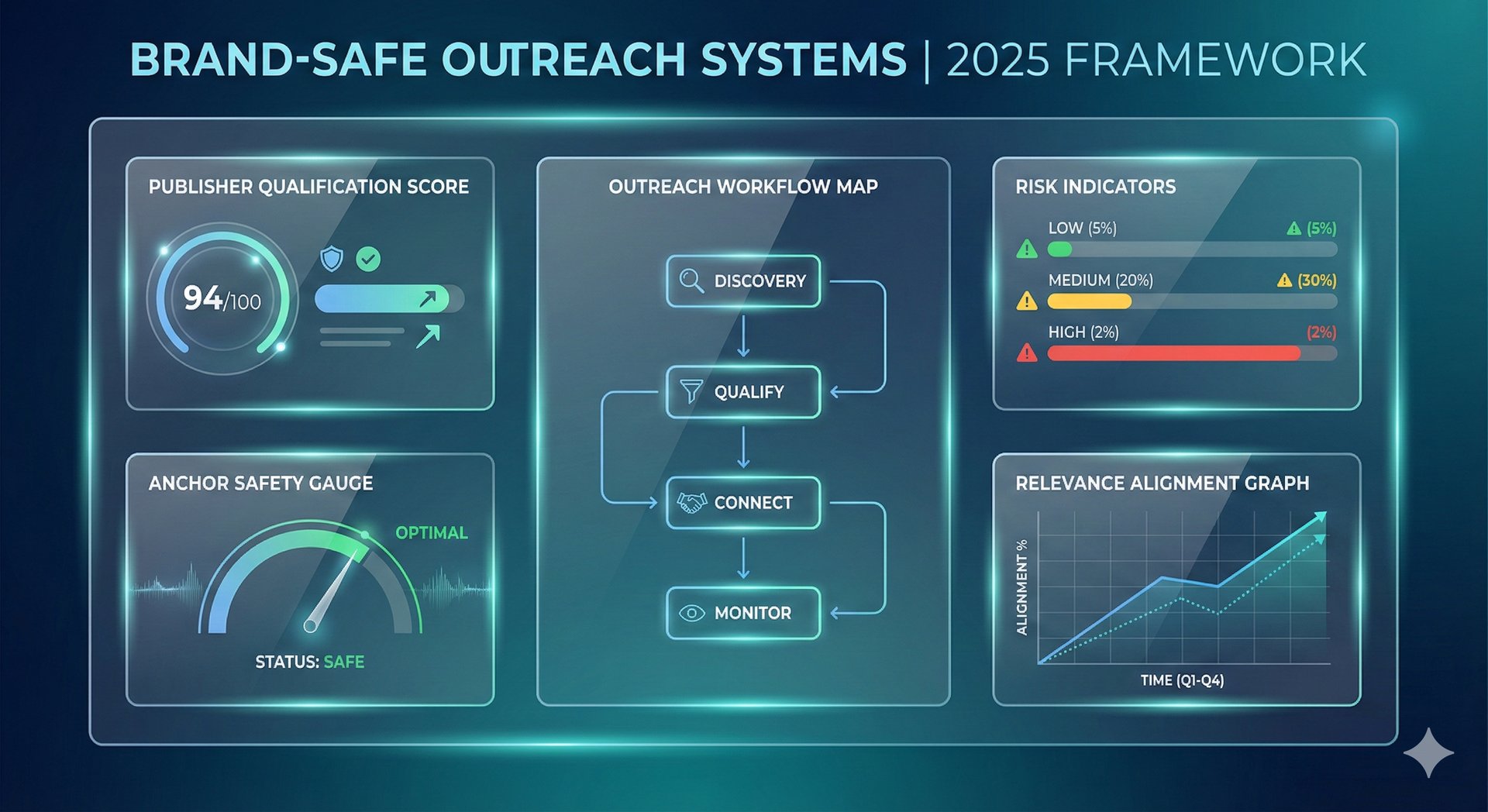
Outreach hasn’t become harder in 2025 — the mistakes have just become more visible.
Founders aren’t afraid of “fewer replies” or “slow campaigns.”
They’re afraid of the things that destroy trust overnight:
A risky publisher slipping into the link profile
AI-written articles masquerading as editorial content
Network footprints showing up in Search Console
Over-automated systems leaving anchor patterns vulnerable
A junior outreach team forcing unnatural placements
Sudden volatility after an update
The truth is simple:
Scaling outreach is not the problem. Scaling poor judgment is.
Most agencies can send emails.
Very few can build brand-safe, relevance-driven, editorial-quality backlinks at scale without drifting into danger.
At Growth Outreach Lab, our model combines:
Systems thinking (repeatable workflows, qualification layers, governance)
Human reasoning (editorial tone checks, contextual fit, risk detection, judgment calls)
This hybrid approach is why our clients — agencies, SaaS teams, and B2B brands across the US, UK, and Canada — trust us with outreach that actually protects their brand.
This is our 2025 brand-safe outreach framework — the same internal playbook we use every day.
1.Why Scalable Outreach Fails in 2025 (Most Agencies Get This Wrong)
Most outreach failures aren’t caused by volume.
They're caused by what volume amplifies.
1. Over-Automation Creates Invisible Damage
Tools promise “smart personalization” and “automated prospecting,” but automation can’t detect:
editorial tone mismatches
network footprints
unnatural topical drift
human vs. AI-generated content
These errors compound at scale.
2. Template Blasting Burns Publisher Relationships
Editors usually forgive one bad pitch.
They don't forgive 40 identical emails sent in one afternoon.
This is why most agencies see declining reply rates over time — they scale the wrong behaviors.
3. Poor Site Qualification Creates Hidden Risk
Most outreach teams look at:
DR
DA
traffic charts
But those metrics tell you nothing about:
editorial integrity
outbound link patterns
sponsored density
category dilution
indexation stability
This is why “high DR” links still cause volatility.
4. Anchor Misuse Is Now a Major Risk Signal
Google has grown extremely good at detecting:
over-optimized anchors
commercial keyword clustering
repetitive anchor placement locations
anchors that don't match editorial tone
In 2025, anchor misuse penalizes judgment, not keywords.
5. Editor Fatigue Creates Low-Quality Links
Editors who are overwhelmed accept:
lower quality content
broader topics
more outbound links
repeated commercial anchors
This dilutes the quality of every placement after them.
6. No Brand-Safety Logic = Long-Term Exposure
Most teams optimize for:
number of links
fast delivery
low cost
But founders care about:
risk
stability
long-term compounding value
link neighborhoods
Outreach output ≠ outreach success.
Success = placements that withstand time, updates, and scrutiny.
2.The 2025 Brand-Safe Outreach Framework (Our Internal Model)
This is the real system we use at Growth Outreach Lab — the one we refine after every campaign, update, and editorial cycle.
Pillar 1 — Publisher Qualification Layer
Before we pitch anything, every publisher is reviewed manually for:
editorial tone authenticity
author diversity
outbound link health
indexation stability
sponsored pattern density
content-to-commercial ratio
ownership networks
Goal: Remove 80% of the internet before outreach begins.
Pillar 2 — Relevance & Topic-Mapping Engine
We map:
client’s topical graph
content pillars
internal anchor opportunities
organic keyword clusters
We only pitch publishers whose audience and editorial scope genuinely overlap with the client’s subject matter.
Goal: Relevance before opportunity.
Pillar 3 — Editor Identification Logic
We find:
editors with a real voice
contributors with consistent bylines
industry-aligned writers
publications with active editorial cycles
No generic “info@” inboxes.
We contact people — never inboxes.
Pillar 4 — Pitch Engineering Framework
Every pitch is engineered using:
topic alignment
editorial tone mirroring
value delivery
relevance-first positioning
We don’t pitch keywords.
We pitch ideas editors actually want.
Pillar 5 — Brand-Safe Anchor Governance
Anchors are governed by:
hierarchy of anchor classes (branded → contextual → partial → navigational)
internal anchor distribution
editorial readability
risk scoring
Our rule:
No anchor should feel like it was placed. It should feel like it belongs.
Pillar 6 — Risk Scoring & Red Flags
Every potential placement is scored for:
patterns of automation
keyword density
suspicious traffic spikes
network footprints
inconsistent authorship
low editorial effort
If it scores high-risk, it’s removed — no matter the DR.
Pillar 7 — Scalable Systems Without Brute-Force Automation
Our system scales:
qualification
organization
tracking
content briefing
follow-ups
But judgment — the part automation gets wrong — is always human.
This is why our placements stay safe.
3.How We Build Repeatable Systems Without Sacrificing Judgment
Scaling outreach is easy.
Scaling good decisions is not.
We use hybrid automation:
Data Helps:
identify active publishers
track editor responsiveness
map anchor usage
spot risk patterns
monitor placement stability
Humans Decide:
Is this article written by a real person?
Does this tone match our client’s positioning?
Will this link still look natural in 2 years?
Does this publisher drift into irrelevant categories?
Would I proudly show this link to a client’s board?
Most agencies scale tools.
We scale judgment frameworks.
4.Our Outreach Workflow (Step-by-Step)
Here’s the real workflow we use across campaigns:
Step 1 — Pre-Qualification
Remove unsafe or irrelevant publishers before outreach begins.
Step 2 — Context Sheet Creation
For every client we maintain a living context document:
positioning
target articles
approved topics
anchor governance rules
risk flags
Step 3 — Pitch Relevance Mapping
Every pitch is mapped to:
a topic cluster
a supporting internal page
a natural anchor
an editorial gap in the publication
Step 4 — Editor-First Outreach
We personalize communication based on:
tone
editorial preferences
their past content
writing cadence
Step 5 — Anchor Selection
Anchors are chosen based on:
contextual fit
risk scoring
distribution balance
editorial tone
Step 6 — Post-Placement Audit
We audit:
context around the link
editorial placement
indexation
anchor position
outbound link neighborhood
Step 7 — Historical Consistency Tracking
We maintain historical logs of:
anchor trends
publisher behavior
editorial changes
link health
This long-term tracking is why our outreach compounds safely.
5.Risk Signals We Watch That Most Teams Miss
Most outreach teams ignore the signals that actually matter.
Ownership Networks
Sites registered under the same owner with different branding.
Template-Level Footprints
Repeated layout patterns = manufactured publishing.
Sponsored Density
Too many “guest posts” silently flagged by Google’s systems.
Clustered Anchor Repetition
Multiple posts on the site use the same commercial phrases.
Non-Human Tone
Articles that read algorithmically perfect — a major AI footprint.
Indexation Stability
If a site loses 10% of its articles from the index, it’s unsafe.
Category Drift
A “tech” site publishing crypto → pets → casinos → SaaS.
These are not metrics.
These are risk signals.
6.How This Framework Protects Brands Long-Term
When outreach is brand-safe:
authority grows steadily
volatility decreases
link neighborhoods remain clean
anchors diversify naturally
updates become manageable
long-term trust compounds
This framework isn’t built for shortcuts.
It’s built for defensible SEO — the kind founders actually sleep well with.
CONCLUSION
Outreach isn’t about sending emails.
It’s about protecting brand reputation at scale.
In 2025, the agencies that win aren’t the fastest — they’re the safest.
The ones that understand:
relevance is non-negotiable
editorial integrity matters
risk governance protects clients
judgment outperforms automation
systems are only as good as the operators behind them
At Growth Outreach Lab, every placement, every anchor, every pitch follows one principle:
Safety first. Relevance second. Scale third. Always in that order.
Because in outreach — just like in finance — downside protection determines long-term success.
Contact
Get in touch
Partner inquiries:
info@growthoutreachlab.com
© 2026 Growth Outreach Lab | Crafted with strategy & intent.
Your Clients Expect Results.
Make Fulfillment the Easiest Part of Your Agency.
Services
Strategy Sample
Our SEO Process